“Ordinary things consistently done produce extraordinary results.” -keith
so, we discuss about bond markets in which we discuss about how many markets are there.
BONDS MARKET
The bond market—often called the debt market, fixed-income market, or credit market—is the collective name given to all trades and issues of debt securities. Governments typically issue bonds in order to raise capital to pay down debts or fund infrastructural improvements.
Publicly traded companies issue bonds when they need to finance business expansion projects or maintain ongoing operations
Understanding Bond Markets
The bond market is broadly segmented into two different silos: the primary market and the secondary market. The primary market is frequently referred to as the “new issues” market in which transactions strictly occur directly between the bond issuers and the bond buyers. In essence, the primary market yields the creation of brand-new debt securities that have not previously been offered to the public.
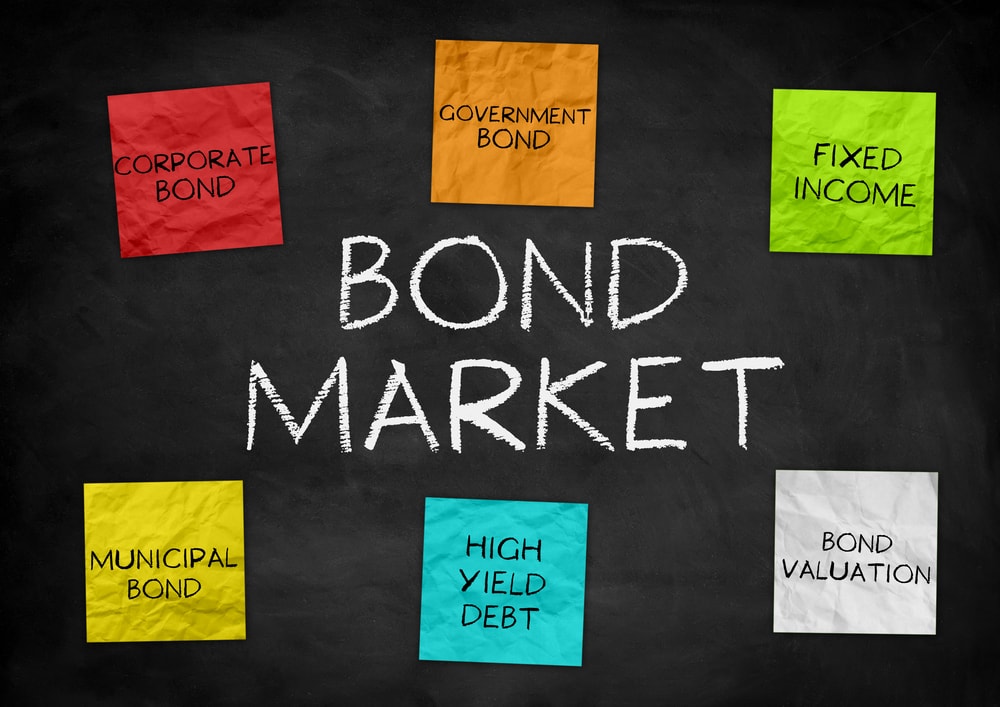
Corporate Bonds
Companies issue corporate bonds to raise money for a sundry of reasons, such as financing current operations, expanding product lines, or opening up new manufacturing facilities. Corporate bonds usually describe longer-term debt instruments that provide a maturity of at least one year.
Government Bonds
National-issued government bonds (or sovereign bonds) entice buyers by paying out the face value listed on the bond certificate, on the agreed maturity date, while also issuing periodic interest payments along the way. This characteristic makes government bonds attractive to conservative investors. Because sovereign debt is backed by a government that can tax its citizens or print money to cover the payments, these are considered the least risky type of bonds, in general.
Municipal Bonds
Municipal bonds—commonly abbreviated as “muni” bonds—are locally issued by states, cities, special-purpose districts, public utility districts, school districts, publicly-owned airports and seaports, and other government-owned entities who seek to raise cash to fund various projects.
Mortgage-Backed Bonds (MBS)
MBS issues, which consist of pooled mortgages on real estate properties, are locked in by the pledge of particular collateralized assets. The investor who buys a mortgage-backed security is essentially lending money to homebuyers through their lenders. These typically pay monthly, quarterly, or semi-annual interest.
Emerging Market Bonds
These are bonds issued by governments and companies located in emerging market economies, these bonds provide much greater growth opportunities, but also greater risk, than domestic or developed bond markets.
Emerging Market Bonds
These are bonds issued by governments and companies located in emerging market economies, these bonds provide much greater growth opportunities, but also greater risk, than domestic or developed bond markets.
Market Trend
What is a market trend?
Looking for a market trend definition? It’s the perceived direction of price movements over a particular period. Market trends apply to all assets and all markets where there’s movement on prices or volumes bought and sold.

What you need to know about market trends…
Four major factors are generally thought to shape market trends:
- Governments, through fiscal and monetary policy, can slow down or speed up growth
- The flow of funds between countries – both inward and outward – can impact the strength of a country’s economy and its currency
- Speculation can create an expectation of future price rates and trend direction
- Supply and demand for products, currencies and other investments creates movement in prices, both up and down depending on who wants what, and whether it’s available
Market terminology
Statues of the two symbolic beasts of finance, the bear and the bull, in front of the Frankfurt Stock Exchange.Further information: Bull (stock market speculator) and Bull–bear line
The terms “bull market” and “bear market” describe upward and downward market trends, respectively, and can be used to describe either the market as a whole or specific sectors and securities. The names perhaps correspond to the fact that a bull attacks by lifting its horns upward, while a bear strikes with its claws in a downward motion.
These terms are first documented by Thomas Mortimer in his book Every Man His Own Broker.
Secular trends
A secular market trend is a long-term trend that lasts 5 to 25 years and consists of a series of primary trends. A secular bear market consists of smaller bull markets and larger bear markets; a secular bull market consists of larger bull markets and smaller bear markets.
Primary trends
A primary trend has broad support throughout the entire market (most sectors) and lasts for a year or more.
Bull market
A 1901 cartoon depicting financier J. P. Morgan as a bull with eager investorsSee also: Bull (stock market speculator)
A bull market is a period of generally rising prices. The start of a bull market is marked by widespread pessimism. This point is when the “crowd” is the most “bearish”. The feeling of despondency changes to hope, “optimism”, and eventually euphoria, as the bull runs its course. This often leads the economic cycle, for example in a full recession, or earlier.
Generally, bull markets begin when stocks rise 20% from their low, and end when stocks drawdown 20%.However, some analysts suggest a bull market cannot happen within a bear market.
Examples
India’s Bombay Stock Exchange Index, BSE SENSEX, had a major bull market trend for about five years from April 2003 to January 2008 as it increased from 2,900 points to 21,000 points, more than a 600% return in 5 years.[citation needed]Notable bull markets marked the 1925–1929, 1953–1957 and the 1993–1997 periods when the U.S. and many other stock markets rose; while the first period ended abruptly with the start of the Great Depression, the end of the later time periods were mostly periods of soft landing, which became large bear markets. (see: Recession of 1960–61 and the dot-com bubble in 2000–2001)
Bear market[edit]
Sculpture of stock market bear outside International Financial Services Centre, Dublin
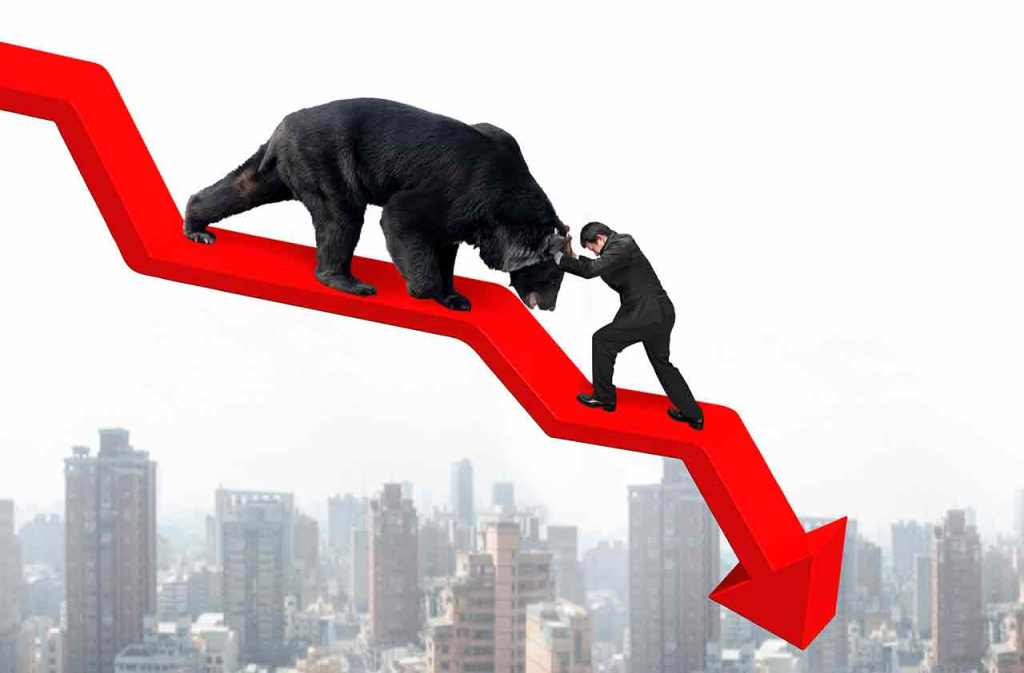
A bear market is a general decline in the stock market over a period of time. It includes a transition from high investor optimism to widespread investor fear and pessimism. One generally accepted measure of a bear market is a price decline of 20% or more over at least a two-month period.
A smaller decline of 10 to 20% is considered a correction.
Examples
A bear market followed the Wall Street Crash of 1929 and erased 89% (from 386 to 40) of the Dow Jones Industrial Average‘s market capitalization by July 1932, marking the start of the Great Depression. After regaining nearly 50% of its losses, a longer bear market from 1937 to 1942 occurred in which the market was again cut in half. Another long-term bear market occurred from about 1973 to 1982, encompassing the 1970s energy crisis and the high unemployment of the early 1980s. One more bear market happened in India following the 1992 Indian Stock Market scam Another bear market was the Stock market downturn of 2002. Yet another bear market occurred between October 2007 and March 2009 as a result of the financial crisis of 2007–2008. The 2015 Chinese stock market crash was also a bear market. In early 2020, as a result of the COVID-19 pandemic, multiple stock market crashes have led to bear markets across the world, many of which are still ongoing.
Financial system
A financial system is a system that allows the exchange of funds between financial market participants such as lenders, investors, and borrowers. Financial systems operate at national and global levels. Financial institutions consist of complex, closely related services, markets, and institutions intended to provide an efficient and regular linkage between investors and depositors.
In other words, financial systems can be known wherever there exists the exchange of a financial medium (money) while there is a reallocation of funds into needy areas (financial markets, business firms, banks) to utilize the potential of ideal money and place it in use to get benefits out of it. This whole mechanism is known as a financial system.

The components of a financial system
There are mainly four components of the financial system:
- Financial markets – the market place where buyers and sellers interact with each other and participate in the trading of bonds, shares and other assets are called financial markets.
- Financial assets – the products which are traded in the financial markets are called financial assets. Based on different requirements and credit seekers, the securities in the market also differ from each others.
- Financial institutions – financial institutions are acting as a mediator between the investors and borrowers. They provide financial services for members and clients. It is also termed as financial intermediaries because they act as middlemen between the savers and borrowers. The investor’s savings are mobilized either directly or indirectly via the financial markets. They offer services to organisations who want to raise funds from markets and take care of financial assets (deposits, securities, loan, etc).
- Financial services – services provided by assets management and liabilities management companies. They help to get the required funds and also make sure that they are efficiently invested. (eg. banking services, insurance services and investment services).
 Stock Market


